Modern Industrial Processing vs Traditional Handcrafting
Industrial and handcraft tobacco processing ultimately differ in control density and objective function. This article dissects their real differences across efficiency, consistency, and flavor complexity.
In November 2021, I stood for nearly two hours on the observation walkway of a threshing and redrying plant near Yuxi, Yunnan. The tobacco leaves on the conveyor belt passed through weighing, cleaning, threshing, and redrying at a steady pace. The moisture target on the large screen read 11%–13% — one of the process windows. The shift leader checked the online moisture and outlet temperature every ten minutes or so. Three days later, I was helping unload poles in a farmer's curing barn in a county in Guizhou: same tobacco leaves, but no PLC, no statistical process control charts — only hands pinching the midrib, smelling the stack temperature, and watching the weather. Both sides were "processing tobacco," but their objective functions were completely different — one side had to turn tens of thousands of kilograms of leaves into interchangeable industrial raw material at a fixed rhythm; the other had to minimize mold, green leaf, and impurities with limited labor and weather conditions, turning a season's harvest into marketable tobacco bundles.
This article does not take sides between "industrial advancement" and "handcraft has more soul." I simply want to straighten out the three axes of efficiency, consistency, and flavor complexity, clarify exactly where modern industrial processing differs from traditional handcrafting, and address the specific issues I repeatedly encountered on-site.
I. First, Clarify: What Each Side's "Processing" Means
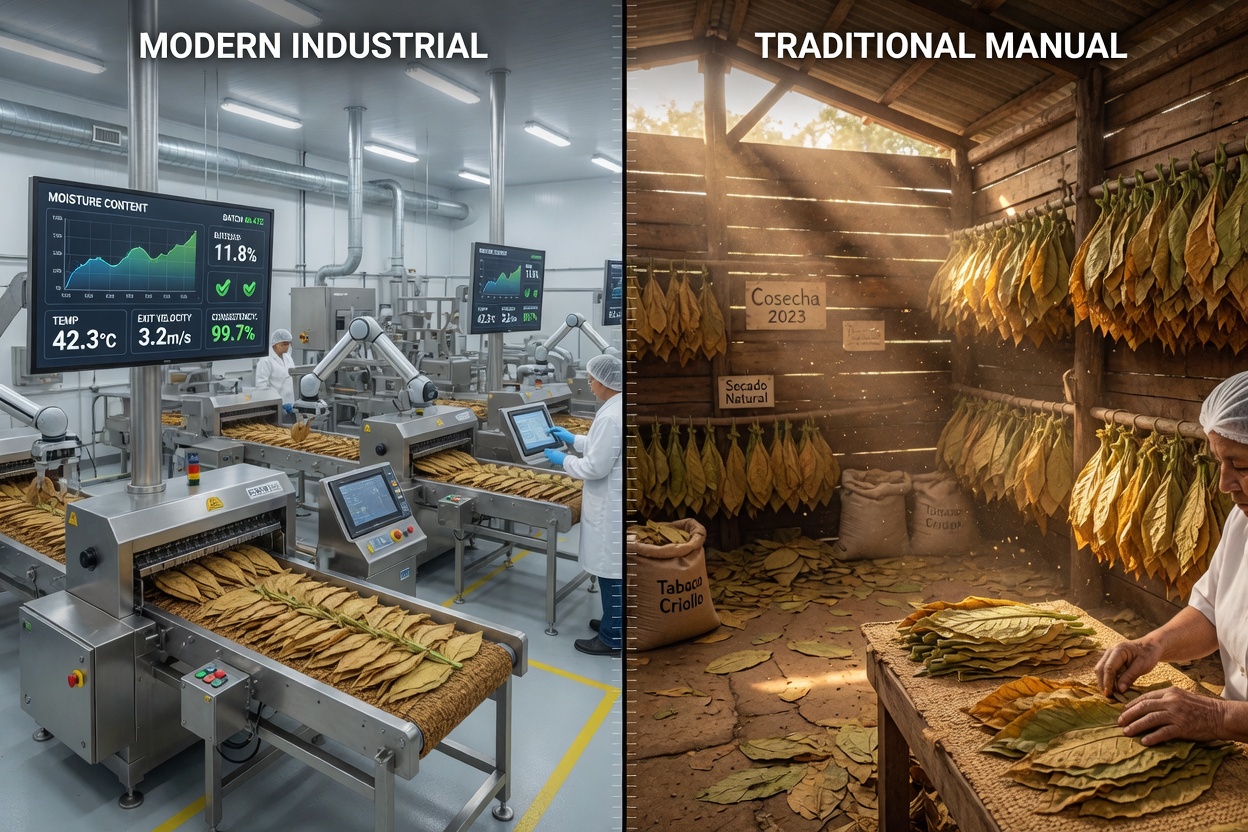
Discussion often goes astray when concepts aren't aligned.
| Dimension | Modern Industrial Processing (as referred to in this article) | Traditional Handcrafting (as referred to in this article) |
|---|---|---|
| Typical Scenarios | Bulk curing barn clusters, threshing and redrying, primary processing line, rolling and packing line, online quality inspection | Farmer curing barns/drying yards, hand sorting and grading, bundling, natural warehouse aging, small-batch hand-rolling (e.g., cigars) |
| Control Methods | Temperature and humidity curves, PLC/DCS, SOP, metered casing and flavoring, statistical sampling | Experience and feel, weather, turning/pole-hanging rhythm, master visual inspection and nose-smelling |
| Product Goal | Stable specifications, batch replaceability, controllable cost and capacity | Batch character, expression of stalk position, small-batch style; sometimes serving local procurement |
| Scale | Tons to tens of tons per day of raw material and semi-finished product | Kilograms to hundreds of kilograms is more common |
Two more distinctions:
- "Industrial/handcraft" is not synonymous with "flue-cured/air-cured varieties." Flue-cured tobacco can go into bulk curing barns or be cured in simple traditional kilns; air-cured tobacco can undergo industrial warehouse fermentation or rely entirely on manual turning.
- Processing changes the chemical profile and sensory usability, not the health license. Whether industrial or handcraft, tobacco exposure itself carries clear health risks — the discussion below is about flavor, not about "which is healthier."
II. Efficiency: Time and Labor Accounting
1. Industrial Side: Trading Capital for Rhythm
Bulk curing barns advanced curing from "depending on the weather" to "following a curve." The complete cycle for one batch of flue-cured tobacco is commonly in the range of approximately 5–8 days (yellowing—color fixing—stem drying, varying by leaf condition and barn type). The key isn't "a few days faster," but parallelization and reproducibility: a barn cluster can run over a dozen batches simultaneously. Personnel shift from "watching full-time" to "inspecting and adjusting curves."
At the threshing and redrying and primary processing stages, the efficiency gap widens to an order of magnitude:
- Threshing and Redrying: A continuous line processes tens of tons of tobacco leaves daily (specific capacity varies by line configuration); cleaning, threshing, redrying, and packing are sequential steps, with extremely high downtime costs.
- Primary Processing: Conditioning, cutting, drying, casing and flavoring run according to recipe cards; cut width, outlet moisture, and filling power all have target ranges. After one shift, the output is ready-to-roll cut filler, not loose leaves that need guessing.
- Rolling and Packing: High-speed machines can reach thousands of sticks per minute (varies significantly by model), with online rejection for weight, loose ends, and appearance — the essence of efficiency is moving uncertainty forward into the process window.
In spring 2022, I followed an early shift at a primary processing plant in South China. Work started at 7:00, with moisture at the conditioning cylinder outlet fluctuating near the target zone; around 9:30, the drying outlet moisture was about 0.5–1 percentage point above target (according to the shift leader and instrument reading). The entire strand felt "brittle," and quality control demanded stricter sampling. Not a major issue, but it disrupted the shift rhythm for nearly 40 minutes: adjusting parameters, isolating suspect segments, and performing additional sensory checks. Industrial efficiency is high, but the cost of downtime and isolation is also high — you gain stable rhythm, and pay system maintenance and exception response costs.
2. Handcraft Side: Trading Person-Days for Flexibility
In a farmer's curing barn, from hanging to being ready for removal, one pole of tobacco typically takes several weeks (depending greatly on weather humidity variation). With limited labor, the truly labor-intensive tasks are:
- Harvesting, sorting, and hanging on poles;
- Adjusting poles, protecting from rain and stuffiness mid-process;
- Conditioning, leaf selection, and tying into bundles after removal;
- Warehouse inspection and turning (if doing stacked aging).
In September 2019, I helped select leaves at a farm in southern Guizhou. Four people sat from 8:00 AM to 4:30 PM, stopping only for one meal, and processed only about 70 kilograms of high-grade usable leaves — the rest were green, damaged, diseased, or "saleable but not at a good price." Is that inefficient? By kilograms per person-day, certainly. But that household's logic wasn't daily output — it was: pick out the limited good leaves, don't mix a season's effort into a low grade.
The "efficiency" of handcraft is often misunderstood. It's not that it can't be fast — it's that fast means something different: facing sudden weather, a household can get up at 3:00 AM to take down poles; facing a special order, a small workshop can stop regular work to focus on one stalk position or one fermentation level. An industrial line making such "sharp turns" is very expensive; handcraft doing "large-batch uniformity" is too slow.
My view:
On efficiency, industry crushes handcraft in standardized output per unit time and unit labor — this is an engineering issue, not an aesthetic one. But if your goal is "preserving the stalk position differences and story of a particular batch," the "slowness" of handcraft is a different resource allocation — trading time for discernment.
III. Consistency: SOP vs Feel — Which is More "Accurate"?
1. Industry Requires Replaceability
The tobacco blend formula in cigarette manufacturing has a cold premise: today's B-grade filler must be able to replace last week's B-grade filler, otherwise the entire supply chain shakes. Consistency is broken into measurable indicators:
- Moisture content window;
- Cut width and whole-cut rate;
- Filling power and combustion-related performance;
- Weight accuracy of casing and flavoring ratios;
- Appearance and foreign material control.
Consistency doesn't mean "all leaves taste equally sweet" — it means fluctuation is locked inside a statistical cage. Non-conforming samples can be returned to the previous process or isolated; metering deviations in the flavoring tank trigger alarms. Human subjectivity still exists — smoking evaluation panels, standard sample comparisons — but subjectivity is embedded in the system, not left to how comfortable someone's throat feels that day.
2. Handcraft Requires "This Batch Passes"
Traditional processing does not mean no standards. Regional procurement has grade rulers, cigar workshops have internal reference samples, and old hands can judge in half a minute whether the midrib humidity is "ready for bundling." However, the rulers are often:
- Relative: today is drier than yesterday; this batch is more mixed than the neighboring village's;
- Situational: three consecutive rainy days change the entire curing barn strategy;
- Personal: when the same master has a stuffy nose from a cold, his judgment of off-odors becomes duller.
In July 2020, a small workshop in Guizhou was coordinating the stacking of dark air-cured tobacco. The stack core temperature once felt noticeably hot (the master estimated around over 40°C in subjective sensation, no lab record). They dismantled the stack overnight to cool it. By industrial logic, this was a process loss of control; by handcraft logic, this was "experience applying the brakes in time." The result: that batch had a rougher irritation than expected, but the aroma had a remarkably distinctive nutty-earthy note — consistency lost, character won. A buyer seeking stable supply would reject it; a buyer seeking small-batch character might pay more.
3. The Real Cost Behind Consistency
The cost of industrial consistency is homogenization pressure: stalk position differences, field differences, and weather differences are "flattened" through threshing blending, formula balancing, and casing/flavoring to an acceptable band. The cost of handcraft consistency is unpromisability: it's hard to say whether the next batch can be reproduced; the longer the distribution channel, the higher the complaint risk.
My view:
"Consistency" is not a moral virtue, and "character" is not naturally superior. For mass-market standardized tobacco products, industrial consistency is a baseline capability; for niche appreciation and regional character circulation, handcraft variation is sometimes the selling point itself. Confusing the two with "who tries harder" renders the discussion useless.
IV. Flavor Complexity: "Crafted Stability" or "Residual Variety"
By "complexity" here, I mean sensory layering and variation — not the number of harmful substances, nor the cliché that "more complex is more premium."
1. How the Industrial Path Handles Flavor
Industrialization does not eliminate flavor; it rewrites how flavor is generated and managed:
- Raw Material Side: regional and grade purchasing, chemical and sensory screening, building a blend map;
- Processing Side: curing and redrying fix the basic chemical profile (e.g., the flue-cured path preserves sugar better; the air-cured path tends to lower sugar and different nitrogen-alkaloid characteristics — this is process chemistry, not mysticism);
- Primary Processing Side: casing improves taste and moisture retention, flavoring (essences) fills the style positioning;
- Product Side: formula pushes fluctuations into the brand recognition zone — so consumers still feel "this is the same taste" three years later.
Complexity can be very high — for example, the blending of flue-cured, burley, and oriental tobacco in a blended-type blend is itself a structured flavor engineering. But it is designable complexity: the layering serves the positioning, not "how this batch feels today."
In 2018, I participated in a controlled comparison in the smoking evaluation room (internal training, not a formal paper): using the same brand's formula cut filler, we deliberately removed a portion of a certain filler grade, replacing about 5%–8% with an alternative grade. Most people said "it's about the same" on the first puff; only by the middle did some feel the smoke became "empty" or slightly harsher. This shows that industrial flavor stability relies heavily on redundant design — not single-point dependence on some legendary tobacco leaf.
2. Where Handcraft Complexity Comes From
Traditional handcraft processing often retains more unflattened information:
- Stalk position: lugs, cutters, and tips differ inherently in maturity and chemistry;
- Field and microclimate: slope aspect, fertilization, harvest timing;
- Curing details: ventilation dead spots in the barn, sun exposure intensity, turning uniformity;
- Aging time: slow changes over months to years of natural warehouse storage.
These information layers stack up, often resulting in "this batch has nuts and leather, but the next batch is biased toward green grass." High complexity often arises because variables haven't been locked in a cage, not because handcraft has magical powers.
Hand-rolled cigars take this logic to the extreme: filler, binder, and wrapper have distinct roles; the craftsman controls firmness and the burn channel with their hands. In 2019, I visited a small factory in the Dominican Republic (already semi-industrialized, but the rolling stations were still highly hand-dependent): with the same blend, different rollers on different days produced noticeably different draw resistance — the tightness was visible. Industrial cigarettes use machines to compress circumference and draw resistance into a narrow band; handcraft writes the "human condition" into the product.
3. The Illusion of Complexity
Two common illusions:
- "Industrial = no flavor, all artificial flavoring." Inaccurate. Most industrial work is raw material screening and blend balancing; flavoring is a tool, not the whole story.
- "Handcraft = purer, more complex, better." Also inaccurate. Handcraft can be both rough and messy — it just varies widely; "complexity" is sometimes just defects that haven't been removed.
My view:
Industry excels at predictable flavor structure; handcraft excels at unpredictable batch expressiveness. If you want the same sensory anchor on your daily commute, industrial logic is the better match. If you value the differentiated experience of a particular year, a particular aging room, or a particular craftsman's condition, handcraft logic is a better match. Treating "complexity" as a moral badge overpraises both sides.
V. Two Types of Failures I've Experienced (More Useful Than Slogans)
1. Industrial Failure: The 0.8% Outside the Window
Back to that 2022 primary processing early shift. After the drying outlet moisture deviation was controlled, the shift was "fine" for the moment. The real trouble appeared the next day: the warehouse environment humidity was high, the isolated segment reabsorbed moisture, and spot checks found localized clumping. The handling was very industrial — isolate, reprocess or downgrade, write a deviation report. Losses can be counted in money or reputation, but the path is clear.
The characteristic of industrial failure: parameter out of bounds → systematic response → visible cost. It is rarely romantic, but it is auditable.
2. Handcraft Failure: One Rainstorm and One Close Call
In August 2020, southern Guizhou had continuous rainfall. The household I had helped had two curing barns: one with acceptable ventilation, the other against a hillside. By the third day, the hillside barn showed a noticeable musty smell, with some leaf surfaces becoming sticky. During the day they removed and re-hung poles; at night they carefully raised temperature with charcoal pans (specific methods vary by household — no replicable tutorial details here). Still, some leaves darkened and off-odors increased. In the end, this batch could only go through low-price channels.
The characteristic of handcraft failure: environmental variables > human will. Experience can save lives, but cannot save all the leaves. Without online instruments, you can't even pinpoint which hour the loss began.
These two types of accidents made me lose interest in "which is more reliable." Reliability means asking: Can you price failure, and does your customer accept fluctuation?
VI. A Summary Table, Nailing Down the Three Axes
| Comparison Axis | Modern Industrial Processing | Traditional Handcrafting |
|---|---|---|
| Efficiency | High rhythm, parallelizable, ton-scale processing; high abnormality cost | Low person-day output; flexible changeover and customization |
| Consistency | Indicator window + SOP + online/offline QC; batch replaceable | Experience and weather driven; strong batch character, hard to promise |
| Flavor Complexity | Designable, hedgeable, brandable; easily understood as "stable" | Many variables, much expressiveness; easily romanticized, also genuinely rougher |
| Typical Failure Mode | Parameter out of bounds, equipment abnormality, isolation and downgrading | Mold, mustiness, green grass, grade mixing, irreproducibility |
| Better Matched Demand | Scale supply, brand stability, cost control | Small-batch character, regional story, stalk position expression |
VII. Personal Judgment: Don't Take Sides, Ask "What Are You Buying"
Writing to this point, my position can be summarized in four straightforward sentences:
- On efficiency, industry is an engineering victory. Denying this means you haven't been to a real workshop.
- On consistency, industry sells replaceability, handcraft sells this specific batch. Their pricing logic differs; comparing "who tries harder" is meaningless.
- On flavor, industrial complexity is a designed structure; handcraft complexity is often uneliminated variation. A structure can be very refined, and variation can just be defects.
- On health, neither side has immunity. Processing discussions should not be hijacked into "more natural, therefore safer."
If you are a general reader, remember one practical framework:
- When you need stable, comparable, mass-procurable experiences or raw material specifications → understand industrial logic;
- When you care about vintage, batch, craftsman, and stalk position → understand handcraft logic;
- When you hear "handcraft is definitely more flavorful/safer" or "industry definitely has no soul" → treat that as marketing, not a process conclusion.
When I look at tobacco or products now, my first reaction is no longer "is this handcraft?" but: Who absorbs its fluctuation? Where is the cost of absorption paid? Is the flavor structure designed, or fortuitously preserved? After asking these three questions, the opposition between industry and handcraft shrinks considerably, leaving choice, not allegiance.
VIII. Conclusion
The difference between modern industrial processing and traditional handcrafting ultimately comes down to the density of control and the objective function: one uses instruments, formulas, and rhythm to narrow the world in exchange for stability and capacity; the other uses experience and time to keep the world wide in exchange for flexibility and batch expressiveness. On the three axes of efficiency, consistency, and flavor complexity, there is no single-sided victory — only fitness for different contexts.
Understanding this is to see why raw materials and products wear different faces, not to coat any tobacco product with a layer of nostalgia. The health risks of tobacco exposure are not reduced by "handcraft" and do not disappear with "industry." Seeing the processing logic clearly is already far more useful than taking sides.
Modern Industrial Processing
Uses instruments, formulas, and rhythm to narrow the world for stability and capacity
Traditional Handcrafting
Uses experience and time to keep the world wide for flexibility and batch character